Ideas. Insights. Inspiration for smarter marketing.

Trade Merchandising in Bangladesh: Is it high time for the Telco and MFS companies to shift their approach to innovative solutions? – A Data-Driven Hypothetical Analysis
11/5/20255 min read
An effective retail index comprises the retail space share, the retailer's recommendation share, and the availability of produce or services within the retail space. The share of the space solely depends on the merchandising presence in the retail (in/on-store) space; the availability of the products is in the custody of the distribution team; and the share of the retailer recommendation is a joint effort of both the distribution and trade merchandising teams. So, it is evident that trade merchanting is crucial in retail.
Trade merchandising is always a critical tool for any company to keep their brands at the forefront of consumers' minds. It creates a bridge between other ATL and BTL activities and provides consumers with cues that may influence their purchase decisions at the retail store. FMCG companies are pioneers in initiating the trade merchandising process by deploying point-of-sale materials (POSMs) and displaying their products live. With the introduction of Telco merchandising and MFS merchandising, which primarily rely on POSM (point of sale materials) in the retail space, this retail and trade merchandising has become intensely competitive between companies across industries for the same retail space.
Let’s go through a comparative sample survey of two periods. We surveyed 259 retailers across various categories in 2022. At the time, we found a dominant MFS presence in the retail space, with 82% POSM presence, while Telco and FMCG had 15% and 3% presence, respectively. In 2024, another survey with 106 retailers across the country found a radical shift in the POSM share. MFS once held a significant share, but it has now dropped to 49%, while Telco and FMCG have expanded their market share to 36% and 15%, respectively.
Is there any significant innovative element that has shifted the paradigm? The answer is a big no. It's all about traditional marketing materials and the efficient use of trade marketing field forces. Here comes another question: how long will efficient management of the field force give a competitive edge? Let's assume that efficient management of the field force will provide us with a competitive advantage for several years to come. However, this competition with traditional POSMs creates merchandising clutter in the retail environment, which is less effective than before in creating consumer awareness.
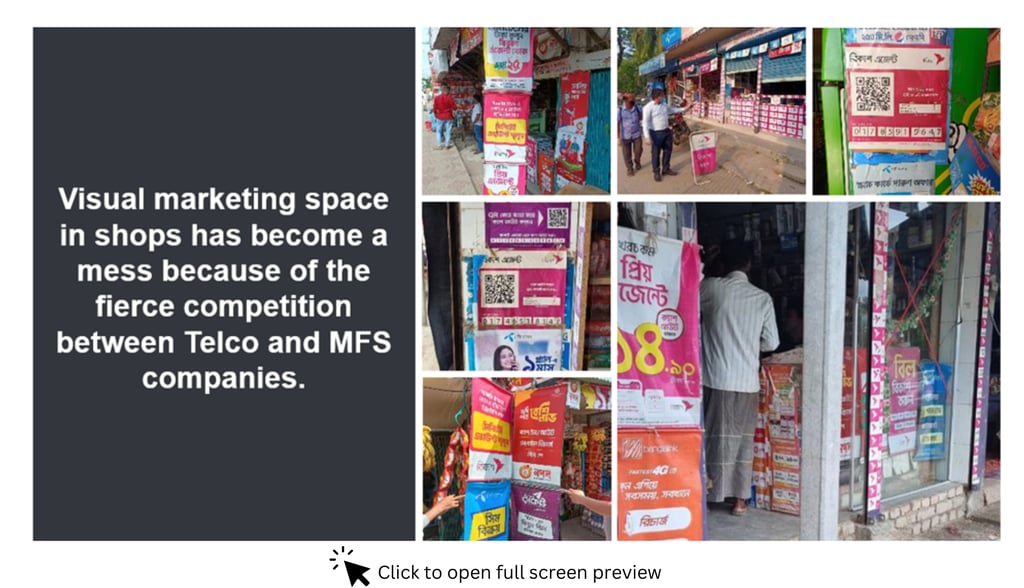
So, what is the solution now? Should we immediately adopt innovative merchandising solutions? The answer lies in two things: cost effectiveness and infrastructure readiness.
To achieve cost-effectiveness, it is necessary to modify the current monitoring process, cut back on human resources and fleet costs, and allocate those savings towards innovative solutions. We should implement a gradual adaptation approach for the infrastructure's readiness. To accomplish this, we must consider three key elements:
The digital merchandising process
Traditional Merchandising in an Innovative Way
Innovative monitoring process
To make it more transparent, let's do an exercise. Suppose a company wants to shift their trade merchandising approach to an entirely innovative one by the next five years. Their approach should be like this:
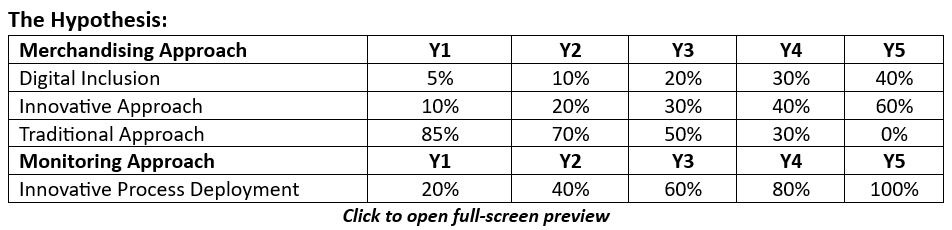
The costs associated with human resources, for example, will decrease as the number of people declines. The price of other components, such as POSM production, toolkits, physical supervision, and others, will also decrease. A portion of the reduced costs or leftover funds can be used to fund the digital and innovative procedure.
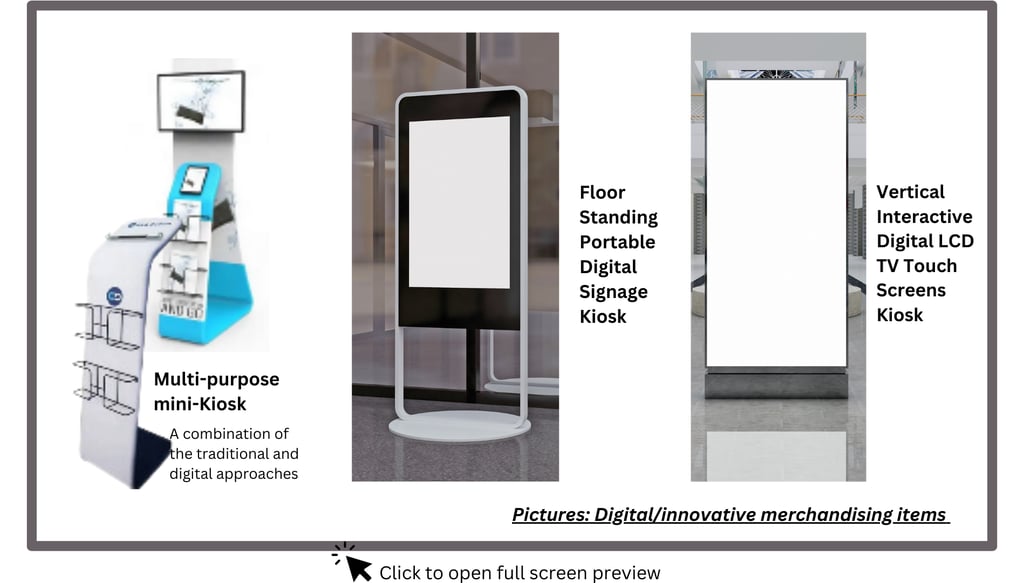
Here are a few examples of digital and innovative merchandising solutions:
Vertical Interactive Digital LCD TV Touch Screen Kiosk
Floor-standing Portable Digital Signage Kiosk
Multi-purpose mini kiosk: a combination of traditional and digital approaches that supports tab or interactive display items, as well as leaflets and brochures.
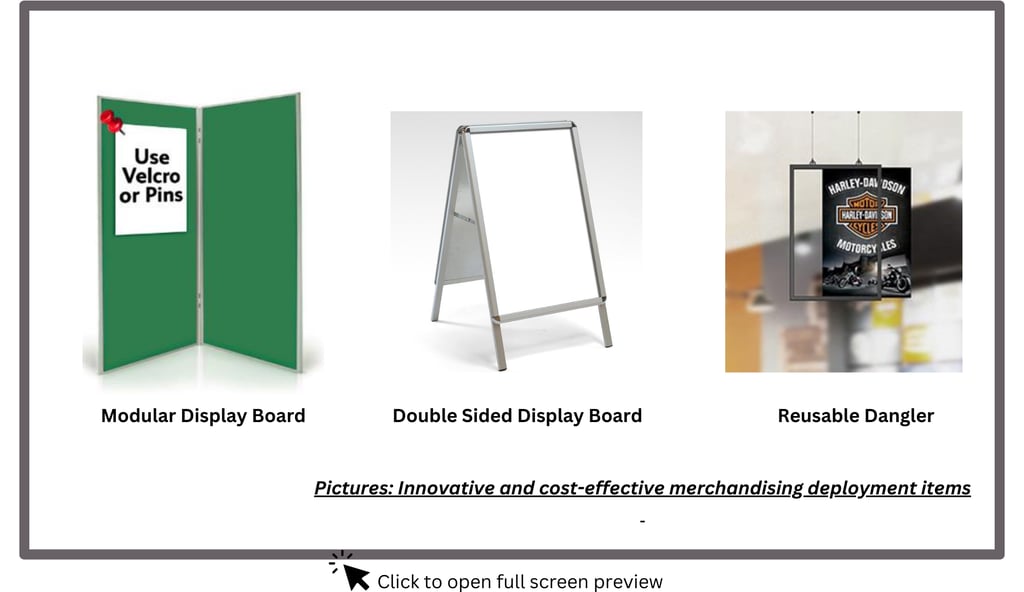
Innovative solutions: A traditional approach with modular solutions will aid in faster execution while increasing retention time. The innovative merchandising deployment items are designed to be both user-friendly and cost-effective.
Reusable Dangler: The old KV can be easily replaced with a new one. This can be LED or non-LED.
Modular Display Board: Using pins and Velcro, display posters in landscape and portrait mode. These boards are simple to assemble and transport.
Aluminum Display Board: It can serve as a multi-purpose and versatile alternative to festoons.
The Concept of Digital Process Management for Monitoring:
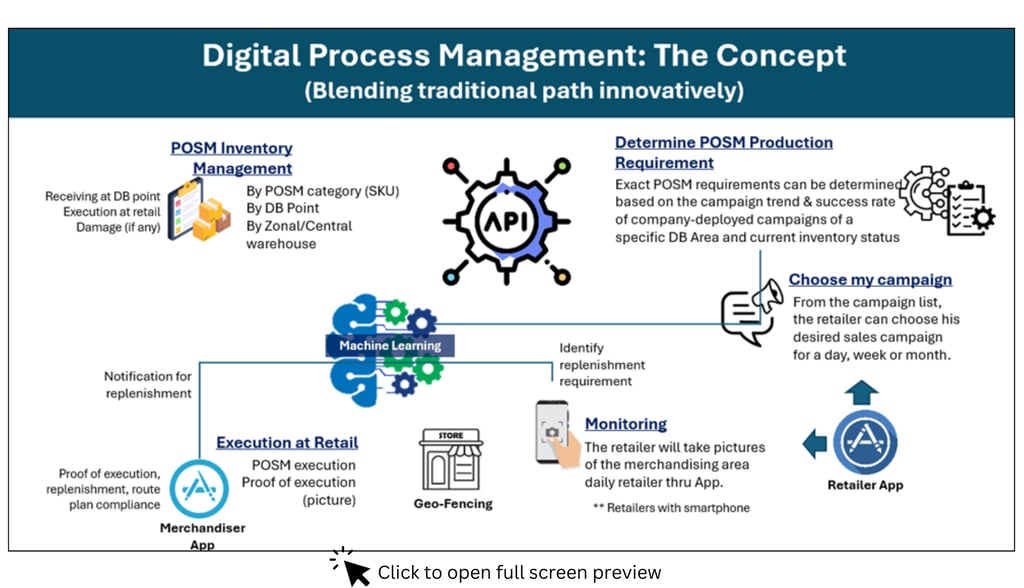
The process is all-encompassing, integrating all stakeholders and workgroups through APIs, ranging from the merchandiser to the retailer to inventory management. An integrated machine learning process will assist the whole process and generate an accurate report by processing input data and pictures.
Retailer as the Key Enabler:
Keep an eye on the execution status.
Ensure that merchandise is retained.
Merchandiser as the executer:
On-time and accurate execution of the POSMs
On-time replenishment as required.
Machine learning as the administrator
Process the data and generate the execution status report.
Assist retailers in choosing their best mix for the business.
Assist the trade team to predict the required production items.
There may be some initial challenges associated with this process.
All the retailers may not have a favorable environment to implement.
Retailers may not willingly submit pictures.
And they may not have a proper smartphone facility.
However, by implementing the system gradually, we can overcome these challenges. We will allocate a portion of the saved budget to the retailer as a reward or incentive for successful picture submission and POSM retention. In the case of devices, any smartphone (low-mid end) will be sufficient, and pictures and data will be saved (if offline) in this process and uploaded once connected to the internet, where machine learning will be worked on in the back end (central server).
The Road Ahead:
It is high time for the MFS and Telco companies to step forward and take on the challenge of shifting the traditional process to an innovative one. There are challenges, but it's up to someone to take the lead and transform the current trade merchandising process into an innovative one. The country possesses the technological capacity to easily accommodate innovative processes. This shift will not only assist the trade merchandising process but also change the mindset of the retailer and retail business process. So, be the pioneer and take the first-mover advantage.