Ideas. Insights. Inspiration for smarter marketing.

Local Distributors Vs Distribution Partners: A comparative evaluation for Bangladeshi FMCG companies pursuing an effective sales and distribution strategy
11/6/20253 min read
FMCG brands use the concept of a national distributor before establishing full-fledged national distribution in the country. Transcom is one of the well-known national distributors of different FMCG brands and companies, and they have been establishing foreign brands through their national distribution network for many years. Abdul Monem and Fair Food & Lifestyle also work as national distributors for various FMCG brands.
On the other hand, FMCG companies that have a full-fledged operation in the country usually appoint local distributors to distribute their products at local retails and wholesales. These local distributors are ideally influential people with sufficient financial capability. In many cases, these local distributors work as distributors for multiple companies in different industries in their locally controlled areas. In recent years, a few local distributors have expanded their boundaries and established distribution processes in multiple areas, even beyond their influential or controlled areas. They are becoming distribution partners rather than only local distributors. Agrani Trading and Asiatic Distribution Limited are among those who serve as distribution partners for different FMCG companies. You can also refer to them as centrally managed local distributors.
Despite its lack of popularity, what makes this distributor model worth considering? Is it just because of better manageability, or are there any tangible benefits for FMCG companies? Let’s go through a comparison between a typical local distributor and a distribution partner.
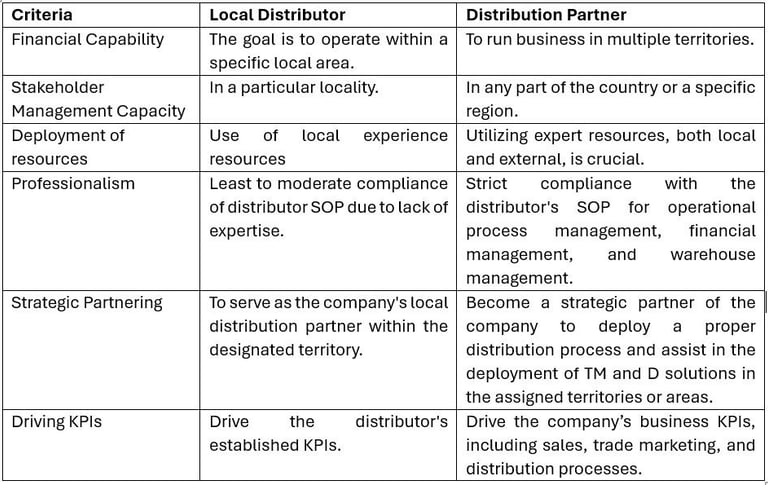
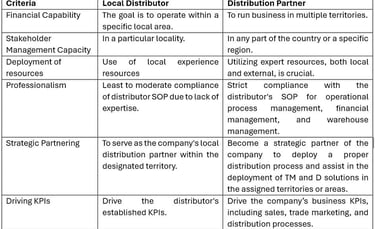
The comparison demonstrates that a local distributor functions as the company's local distribution representative, overseeing the implementation of the distribution process within a specific territory. A distribution partner is more than just a distributor for the appointed company; it has the expertise and capability to assist in the deployment of trade marketing and the company's distribution strategy.
How can a distribution partner add value to the Trade Marketing and Distribution processes?
Implementing distribution process management appropriately (Ensure professional distribution process):
Financial Planning: Accurate financial planning for regular operation management, seasonal impact management, and promotional impact management.
Stakeholder mapping and engagement: identify and list the influencers and stakeholders in each locality, place them on the stakeholder map based on their influence and interest, and engage them accordingly.
Resource planning and deployment entail calculating the required resources to run the operation, identifying the required expertise and experiences of each resource, and sourcing and deploying the appropriate resources.
Strategic assistance to ensure operational excellence (Ensure optimum coverage with the right resources and compliance):
Coverage planning: a proper route plan strategy that ensures an accurate number of frequencies to cover each outlet
Organizational development: design and deploy a proper performance management system, develop resources according to requirements, and establish a one-tea culture.
Platform management: To achieve optimal results, ensure proper management of trade marketing platforms.
Compliance management: Strick compliance in distribution operations and legal proceedings.
Drive the business KPI (Assist the company in implementing sustainable business processes):
Expand distribution and trade marketing coverage in line with the company's business strategy.
Channel development and management: Assist the company in developing business channels and managing them to achieve expected outcomes.
New Product Introduction (NPI) involves the timely and precise placement of new products in the designated retail channels, along with the monitoring and analysis of the placement outcomes.
Companies that depend on the sales and distribution model to connect with consumers must consider alternatives to merely distributing products and services. The appointed distributors must comprehend and anticipate the company's vision and TM & D strategy to ensure that the process and strategy align with the execution plan. For a trade marketing and distribution expert, it is not sufficient to simply deploy distributors who are capable of distributing the company's products and services; rather, the distributor must possess the necessary expertise and capacity to drive the company's business key performance indicators (KPIs). It is imperative to devise a sustainable and effective model that will enhance the efficiency of the sales and distribution process.